![[personal profile]](https://www.dreamwidth.org/img/silk/identity/user.png)

The fate of one burial
Nov. 23rd, 2019 09:08 pmThe order of burial of the remains of a ram and what can happen with this after 4 thousand years ...
I have some experience in burying the bodies of dead goats. After slaughtering the animal, we usually burned in the fire those parts of the carcass that were not used: skin, intestines, hooves. But if the goat was dying, then the carcass had to be buried.
The burial pit should be deep enough, I think that a depth of 1 meter would be enough. If I were in the place of Abraham, I would first get rid of the knife: I would break it and throw the debris to the bottom. The skin of the animal is convenient to use as a bag for intestines and other unused parts of the carcass. This package is thrown to the bottom of the pit after the fragments of the knife.
After this, large stones should be thrown into the pit, almost to the very top. There it is necessary to pour soil, the amount of which for some reason always turns out to be significantly less than the volume of the dug hole. To the very top you need to knock over a large stone, very heavy.
What happens to this burial for 4 thousand years?
The surface of the hill undergoes erosion, the hill becomes lower. A stone lying on top protects the burial from erosion, and gradually, in addition to the upper stone, lower, smaller stones also appear on the surface. This structure is unstable, and with the erosion of the hill, at some point everything crumbles: a large stone falls to the ground, and smaller stones lie near it. Smaller stones are more creeping: they drift year after year along the hillside and the larger stone is closer to the starting place than they are.
Therefore, the fragments of a bronze knife and the remains of a ram should be slightly higher up the slope, relative to the large stone that once lay on top of the burial.
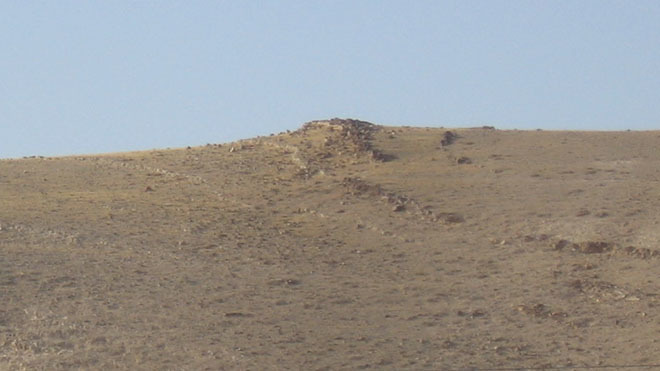
Approximately the same picture should be observed in relation to the ruins of the altar. In the original place of the altar, there must be some elevation of the soil surface, formed during the period when the altar was still intact and its stones protected the soil below them from erosion. When the altar collapsed due to a significant elevation above the hill, the crumbling stones began to drift down the slope, forming a characteristic placer in the direction of the slope.
Apparently, this is what we observe in the only image available to us of this place:

Update. At that place, in addition to three fragments of a bronze knife of the Middle Bronze Age, and in addition to ram bones about 4050 years old, an earthen vessel containing accessories for lighting a fire and stones used by Abraham to make fire can be buried.
I have some experience in burying the bodies of dead goats. After slaughtering the animal, we usually burned in the fire those parts of the carcass that were not used: skin, intestines, hooves. But if the goat was dying, then the carcass had to be buried.
The burial pit should be deep enough, I think that a depth of 1 meter would be enough. If I were in the place of Abraham, I would first get rid of the knife: I would break it and throw the debris to the bottom. The skin of the animal is convenient to use as a bag for intestines and other unused parts of the carcass. This package is thrown to the bottom of the pit after the fragments of the knife.
After this, large stones should be thrown into the pit, almost to the very top. There it is necessary to pour soil, the amount of which for some reason always turns out to be significantly less than the volume of the dug hole. To the very top you need to knock over a large stone, very heavy.
What happens to this burial for 4 thousand years?
The surface of the hill undergoes erosion, the hill becomes lower. A stone lying on top protects the burial from erosion, and gradually, in addition to the upper stone, lower, smaller stones also appear on the surface. This structure is unstable, and with the erosion of the hill, at some point everything crumbles: a large stone falls to the ground, and smaller stones lie near it. Smaller stones are more creeping: they drift year after year along the hillside and the larger stone is closer to the starting place than they are.
Therefore, the fragments of a bronze knife and the remains of a ram should be slightly higher up the slope, relative to the large stone that once lay on top of the burial.
Approximately the same picture should be observed in relation to the ruins of the altar. In the original place of the altar, there must be some elevation of the soil surface, formed during the period when the altar was still intact and its stones protected the soil below them from erosion. When the altar collapsed due to a significant elevation above the hill, the crumbling stones began to drift down the slope, forming a characteristic placer in the direction of the slope.
Apparently, this is what we observe in the only image available to us of this place:
Update. At that place, in addition to three fragments of a bronze knife of the Middle Bronze Age, and in addition to ram bones about 4050 years old, an earthen vessel containing accessories for lighting a fire and stones used by Abraham to make fire can be buried.
Now for Israel. The prophecy of Ezekiel: how to determine the location of the Third Temple. The borders of Israel. The tribes of Israel. The president. The ruins of the altar in the Judean desert. The knife of Abraham. Two creeks.
Once more about the land of Moriah
Sep. 6th, 2018 07:19 am83 And Sarah laid her head upon the bosom of one of her handmaids, and she became as still as a stone.
84 She afterward rose up and went about making inquiries till she came to Hebron, and she inquired of all those whom she met walking in the road, and no one could tell her what had happened to her son.
85 And she came with her maid servants and men servants to Kireath-arba, which is Hebron, and she asked concerning her Son, and she remained there while she sent some of her servants to seek where Abraham had gone with Isaac; they went to seek him in the house of Shem and Eber, and they could not find him, and they sought throughout the land and he was not there.
86 And behold, Satan came to Sarah in the shape of an old man, and he came and stood before her, and he said unto her, I spoke falsely unto thee, for Abraham did not kill his son and he is not dead; and when she heard the word her joy was so exceedingly violent on account of her son, that her soul went out through joy; she died and was gathered to her people.
87 And when Abraham had finished his service he returned with his son Isaac to his young men, and they rose up and went together to Beersheba, and they came home.
88 And Abraham sought for Sarah, and could not find her, and he made inquiries concerning her, and they said unto him, She went as far as Hebron to seek you both where you had gone, for thus was she informed.
89 And Abraham and Isaac went to her to Hebron, and when they found that she was dead they lifted up their voices and wept bitterly over her; and Isaac fell upon his mother's face and wept over her, and he said, O my mother, my mother, how hast thou left me, and where hast thou gone? O how, how hast thou left me!
https://www.sacred-texts.com/chr/apo/jasher/23.htm
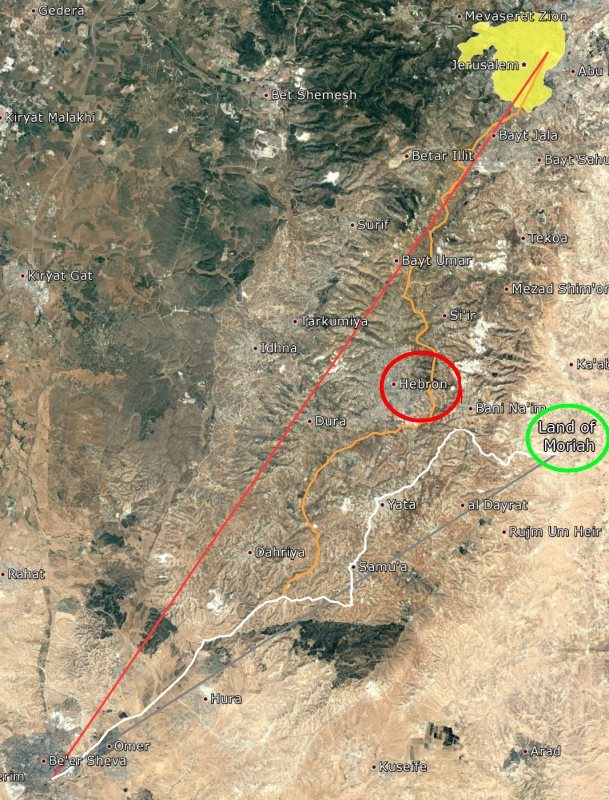
Yes, of course, Abraham could not meet Sarah on the way back, because he was going not from Jerusalem, but from the Judean desert, where the land of Moriah is located.
( Read more... )
After combining the model with the terrane, I noticed a dark spot about 45 meters east of the altar. I think that this is a scattering of stones, left from the ancient altar of Abraham, in the place of Jehovah Jireh. Then the Temple model needs to be moved slightly to the east, so that the new altar is in place of the former altar.

Since I can not be sure that this dark spot on satellite photography is the ruins of an ancient altar, I will not yet move the Temple model 48 meters to the east and 18 meters to the north. Although it seems that it would be more convenient if the northern wall is built a little to the north than it is now: there is a stream and the wall runs right in the center of its channel.
If it turns out that the dark spot on the satellite image is really the ruins of the ancient altar, then we should look for fragments of the bronze knife of Abraham concerning these ruins. The burial of the remains of the sacrificial ram should be where there will be a passage 20 cubits wide (Ezekiel 42:3), which is along the western wall of the temple complex, about 120 meters to the west and a few meters to the south of the center of the ruins of the altar.
Since I can not be sure that this dark spot on satellite photography is the ruins of an ancient altar, I will not yet move the Temple model 48 meters to the east and 18 meters to the north. Although it seems that it would be more convenient if the northern wall is built a little to the north than it is now: there is a stream and the wall runs right in the center of its channel.
If it turns out that the dark spot on the satellite image is really the ruins of the ancient altar, then we should look for fragments of the bronze knife of Abraham concerning these ruins. The burial of the remains of the sacrificial ram should be where there will be a passage 20 cubits wide (Ezekiel 42:3), which is along the western wall of the temple complex, about 120 meters to the west and a few meters to the south of the center of the ruins of the altar.
The History of the Knife of Abraham
Apr. 22nd, 2017 06:42 pm
After we, with the help of geometric constructions based on the prophecy of Ezekiel, were able to accurately determine the location of the future altar of the Third Temple, and after we found on this very place something reminiscent of the ruins of the ancient altar, it is time to look into the details of the sacrifice of Abraham in the land of Moriah.
First, we determined the distance from Be'er Sheva to Jerusalem, because according to Judaic traditions, it was at Mount Moriah in Jerusalem that the sacrifice of Abraham, described in Genesis 22, was performed. And although the distance in a straight line from Be'er Sheva to Jerusalem is only 72 kilometers (45 mi), the actual route along the highway from Be'er Sheva to Jerusalem today is 100-112 kilometers (62-70 mi).
The average daily path of a person is 40 kilometers. The donkey also moves with the speed of a pedestrian, and it is unlikely that you can make it go more than 40 kilometers in one day.
According to the book of Genesis, Abraham set out early in the morning, and came to the place of sacrifice on the third day. In the remaining time he and his son were to build an altar, and then it was necessary to make a sacrifice before sunset. Therefore, we can assume that the entire journey of Abraham took just over two days. Go more than 100 kilometers to Jerusalem, he just would not have had time.
The distance from Be'er Sheva to the place we found in the Judean Desert is only 50 km (31 mi) in a straight line. If we take the same coefficient that we have by calculating the ratio of the distance along the line to the length of the actual path between Be'er Sheva and Jerusalem, then the real path from Be'er Sheva to the place we found in the Judean Desert is about 73 km (45 mi).
Given that in the time of Abraham the road could squirm more than the modern freeway, the real path of Abraham could be even greater, so the place we found is much more suitable as a possible place for Abraham's sacrifice than what the Jewish tradition tries to impose on us.
The second factor that could make the sacrifice of Abraham impossible at the site of the future threshing floor of Ornan the Jebusite is that there was a nearby city where people lived. It is strange to imagine that Abraham would have decided to sacrifice his son in public, before the eyes of the townspeople, who would certainly have gathered to look at this spectacle.
But the most important argument against the version of Jerusalem as a place of Abraham's sacrifice, is that the threshing floor of Ornan the Jebusite in the Bible called the threshing floor of Ornan the Jebusite, and not called the land of Moriah, and not called Jehovah-Jireh.
I want you to notice that in Genesis this place is called "the land of Moriah", and in 2 Chronicles the place where Solomon built the Temple is called "Mount Moriah".
( Read more... )


![[community profile]](https://www.dreamwidth.org/img/silk/identity/community.png)