![[personal profile]](https://www.dreamwidth.org/img/silk/identity/user.png) galgal
galgalLet's try to understand the parameters of the staircases that are in the House of Sanctuary.
The first obstacle for the English-speaking Bible reader is that the English translations of the Bible do not specify the number of steps on the main staircase before entering the porch of the Temple.
KJV:
The length of the porch [was] twenty cubits, and the breadth eleven cubits; and [he brought me] by the steps whereby they went up to it: and [there were] pillars by the posts, one on this side, and another on that side.
NASB:
The length of the porch was twenty cubits and the width eleven cubits; and at the stairway by which it was ascended were columns belonging to the side pillars, one on each side.
(Ezekiel 40:49)
The Russian Synodal translation of the Bible indicates the number of steps at the staircase, but one can hardly rely on the national translations of Ezekiel's book.

Ten steps ... - Translation by the conjecture , which confirms the Septuagint
  .
.
Accepting this hypothesis, based on the Septuagint text, we can determine the height of the staircase on the main staircase of the Temple.
At the very beginning of the measurements of the temple complex, a cane was used to measure the wall. And we also know that in the prophecy of Ezekiel, the cubit was used to measure the length in the Temple. Probably, the height of the first floor of the Temple should be a multiple of an integral number of cubits.
Let us see what may be possible:
1 reed = 6 cubit / 10 steps = 2880 mm / 10 = 288 mm = 11,338″
5 cubit / 10 steps = 2400 / 10 = 240 mm = 9,449″
4 cubit / 10 steps = 1920 / 10 = 192 mm = 7,559″
3 cubit / 10 steps = 1440 / 10 = 144 mm = 5,669″
2 cubit / 10 steps = 960 / 10 = 96 mm = 3,779″
The maximum height of steps of stairs in residential and public buildings is 190 mm.
The minimum step height is 120 mm.
We have only one option: the height of the step in the Temple is 144 mm.
Another important conclusion we got: the floor level of the first floor of the Temple is 3 cubits or 1440 mm.
And we accept the assumption that all the other staircases in the temple complex also have a step height of 144 mm.
If we accept such an assumption, and we assume that the height of any floor of any building of the temple complex is necessarily a multiple of an integer number of elbows, it turns out that only for the height of a floor multiple of 3 elbows, the number of steps at the stairs between the floors will be an integer.
Let us leave for now the question of the height of the secondary buildings of the temple complex. Let's try to understand the question of the design and layout of service stairs in the main building of the temple complex, in the House of Sanctuary.
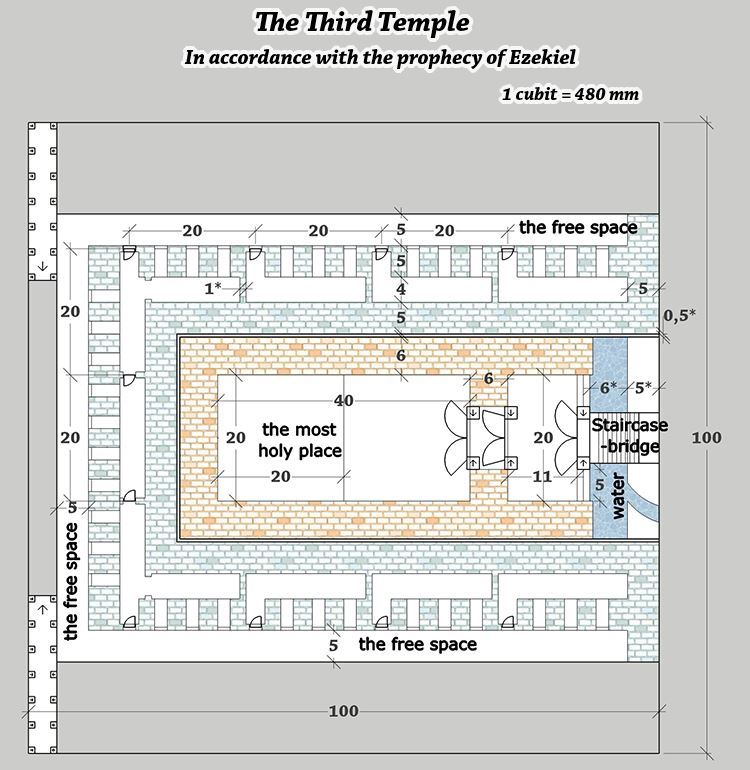
As I have already shown in the drawing of the first floor of the Temple, the storerooms are located on the northern, western and southern sides of the House.
Since Ezekiel's prophecy does not provide space for staircases in the interior of the house where storerooms are located, there is space for staircases only in "free space".
NASB:
The thickness of the outer wall of the side chambers was five cubits. But the free space between the side chambers belonging to the temple.
(Ezekiel 41:9)
NASB:
The doorways of the side chambers toward the free space consisted of one doorway toward the north and another doorway toward the south; and the width of the free space was five cubits all around.
(Ezekiel 41:11)
Since the doors of the rooms only extend to the north and south, for the arrangement of the staircases it is convenient to use only the western, back part of the House. But the space of 5 cubits is too narrow to accommodate a staircase with several flights of stairs. The construction of several stair flights is hampered by the expansion of the house with each successive floor:
NASB:
The side chambers surrounding the temple were wider at each successive story. Because the structure surrounding the temple went upward by stages on all sides of the temple, therefore the width of the temple increased as it went higher; and thus one went up from the lowest story to the highest by way of the second story.
(Ezekiel 41:7)
In this verse of Ezekiel's prophecy there is an important detail: "and thus one went up from the lowest story to the highest by way of the second story".
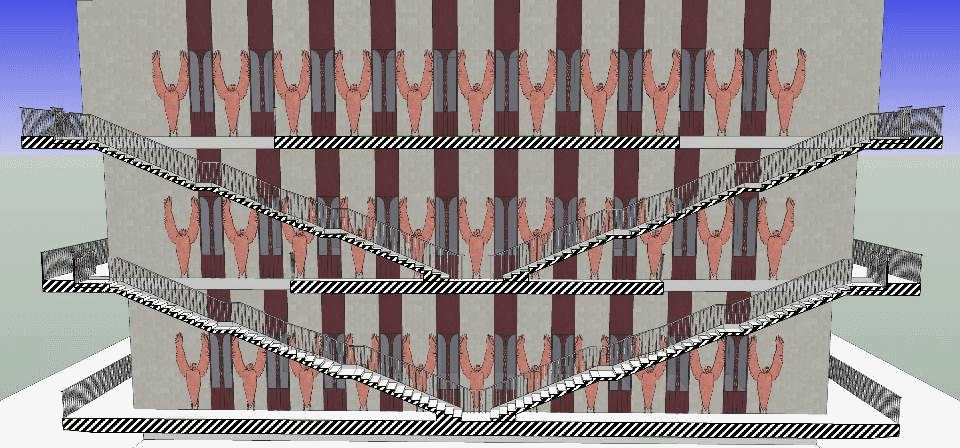
From this phrase it becomes clear that in the Temple of Ezekiel there are no spiral staircases: in order to climb to the third floor, you must first go up to the second floor, then go through the second floor to the staircase leading to the third floor and only then you can climb to the very top.
I will not substantiate in detail the choice of height between the floors in the Temple. We chose a height of 2 reeds (12 cubits or 5,76m). If you choose a smaller height, then the building of the Temple will be very low. If the height between the floors is increased, then with the width of the room on the first floor, equal to 4 cubits, the ceiling will be too high.
With a height between floors equal to 2 reeds, the staircase must have 40 steps.
Construction rules do not allow the construction of stairs with an even number of steps. The number of steps of a ladder on one flight of stairs should be no more than 16.
After some thought, I chose the number of steps for the stairs in this way: 13 + 13 + 13 + 1. (But if you take the console thickness for the "free space" more than 1 cubit, the ladder can have 13 + 13 + 11 + 3 steps, and this more corresponds to the building regulations prohibiting making a ladder in 1 step. But I prefer the option I chose ...)


The first obstacle for the English-speaking Bible reader is that the English translations of the Bible do not specify the number of steps on the main staircase before entering the porch of the Temple.
KJV:
The length of the porch [was] twenty cubits, and the breadth eleven cubits; and [he brought me] by the steps whereby they went up to it: and [there were] pillars by the posts, one on this side, and another on that side.
NASB:
The length of the porch was twenty cubits and the width eleven cubits; and at the stairway by which it was ascended were columns belonging to the side pillars, one on each side.
(Ezekiel 40:49)
The Russian Synodal translation of the Bible indicates the number of steps at the staircase, but one can hardly rely on the national translations of Ezekiel's book.
Ten steps ... - Translation by the conjecture
, which confirms the Septuagint .Accepting this hypothesis, based on the Septuagint text, we can determine the height of the staircase on the main staircase of the Temple.
At the very beginning of the measurements of the temple complex, a cane was used to measure the wall. And we also know that in the prophecy of Ezekiel, the cubit was used to measure the length in the Temple. Probably, the height of the first floor of the Temple should be a multiple of an integral number of cubits.
Let us see what may be possible:
1 reed = 6 cubit / 10 steps = 2880 mm / 10 = 288 mm = 11,338″
5 cubit / 10 steps = 2400 / 10 = 240 mm = 9,449″
4 cubit / 10 steps = 1920 / 10 = 192 mm = 7,559″
3 cubit / 10 steps = 1440 / 10 = 144 mm = 5,669″
2 cubit / 10 steps = 960 / 10 = 96 mm = 3,779″
The maximum height of steps of stairs in residential and public buildings is 190 mm.
The minimum step height is 120 mm.
We have only one option: the height of the step in the Temple is 144 mm.
Another important conclusion we got: the floor level of the first floor of the Temple is 3 cubits or 1440 mm.
And we accept the assumption that all the other staircases in the temple complex also have a step height of 144 mm.
If we accept such an assumption, and we assume that the height of any floor of any building of the temple complex is necessarily a multiple of an integer number of elbows, it turns out that only for the height of a floor multiple of 3 elbows, the number of steps at the stairs between the floors will be an integer.
Let us leave for now the question of the height of the secondary buildings of the temple complex. Let's try to understand the question of the design and layout of service stairs in the main building of the temple complex, in the House of Sanctuary.
As I have already shown in the drawing of the first floor of the Temple, the storerooms are located on the northern, western and southern sides of the House.
Since Ezekiel's prophecy does not provide space for staircases in the interior of the house where storerooms are located, there is space for staircases only in "free space".
NASB:
The thickness of the outer wall of the side chambers was five cubits. But the free space between the side chambers belonging to the temple.
(Ezekiel 41:9)
NASB:
The doorways of the side chambers toward the free space consisted of one doorway toward the north and another doorway toward the south; and the width of the free space was five cubits all around.
(Ezekiel 41:11)
Since the doors of the rooms only extend to the north and south, for the arrangement of the staircases it is convenient to use only the western, back part of the House. But the space of 5 cubits is too narrow to accommodate a staircase with several flights of stairs. The construction of several stair flights is hampered by the expansion of the house with each successive floor:
NASB:
The side chambers surrounding the temple were wider at each successive story. Because the structure surrounding the temple went upward by stages on all sides of the temple, therefore the width of the temple increased as it went higher; and thus one went up from the lowest story to the highest by way of the second story.
(Ezekiel 41:7)
In this verse of Ezekiel's prophecy there is an important detail: "and thus one went up from the lowest story to the highest by way of the second story".
From this phrase it becomes clear that in the Temple of Ezekiel there are no spiral staircases: in order to climb to the third floor, you must first go up to the second floor, then go through the second floor to the staircase leading to the third floor and only then you can climb to the very top.
I will not substantiate in detail the choice of height between the floors in the Temple. We chose a height of 2 reeds (12 cubits or 5,76m). If you choose a smaller height, then the building of the Temple will be very low. If the height between the floors is increased, then with the width of the room on the first floor, equal to 4 cubits, the ceiling will be too high.
With a height between floors equal to 2 reeds, the staircase must have 40 steps.
Construction rules do not allow the construction of stairs with an even number of steps. The number of steps of a ladder on one flight of stairs should be no more than 16.
After some thought, I chose the number of steps for the stairs in this way: 13 + 13 + 13 + 1. (But if you take the console thickness for the "free space" more than 1 cubit, the ladder can have 13 + 13 + 11 + 3 steps, and this more corresponds to the building regulations prohibiting making a ladder in 1 step. But I prefer the option I chose ...)
![[community profile]](https://www.dreamwidth.org/img/silk/identity/community.png)